film soundtrack composer, sound / installation artist, curator – An architect designs works that occupy spaces; I create sound sculptures that fit in the flow of time and perception
In November 2019 and March 2024, France Jobin presented modular concerts at the Ernst Krenek Institute in Austria and we are proud to present those recordings on the legendary vintage Buchla 100 system along with some other analogisms…
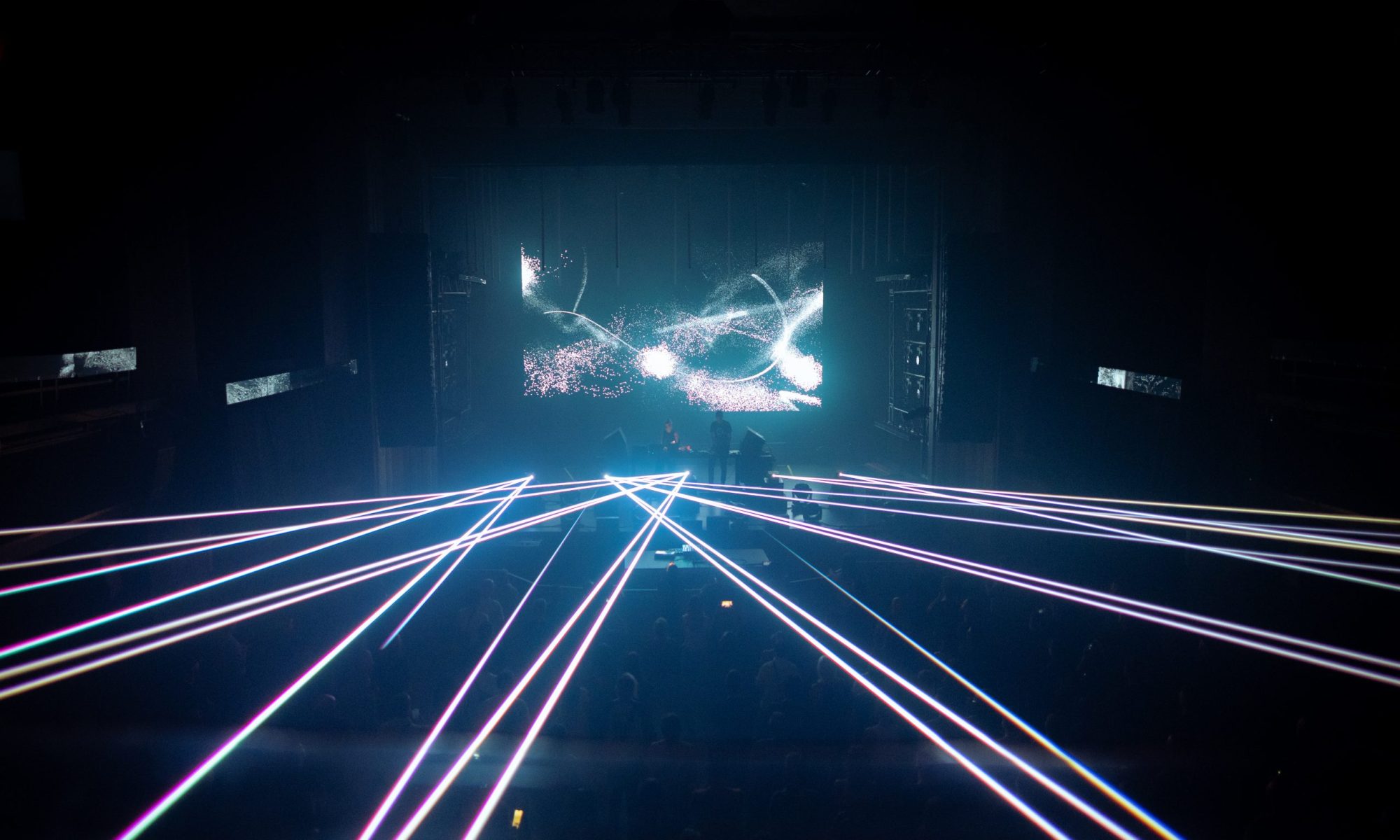
France Jobin is a sound / installation / artist, composer and curator residing in Montreal, Canada. Her audio art can be qualified as “sound-sculpture”, revealing a minimalist approach to complex sound environments where analog and digital intersect. Her installations express a parallel path, incorporating both musical and visual elements inspired by the architecture of physical spaces. Her works can be “experienced” in a variety of unconventional spaces and new technology festivals across Canada, the United States, South America, South Africa, Europe, Australia, Japan and South Korea. Jobin has created solo recordings for Editions Mego (AT), No-ware (CL-DE), Silent Records (USA), popmuzik records (JP), bake/staalplaat (NL), ROOM40 (AU), nvo (AT), DER (US), ATAK (JP), murmur records (JP), Baskaru (FR) and the prestigious LINE label (US). Since 2009, her focus has been related to Quantum mechanics. Many of her projects are inspired by theories related to topics such as vacuum decay, string theory and more recently, what she feels to be the most perplexing phenomenon in the world of the quantum , entanglement resulting in a first presentation, Entanglement A/V, with visual artist Markus Heckmann, which delves into the realms of quantum physics premiered at Mutek Mtl 2021.
As always more infos, interview and pictures when visiting our platform
In a series that has already delivered so many innovative performances, Jobin’s contribution feels both essential and personal. Modulisme Session 123 is a fascinating addition to her already stellar discography and a testament—proof that in the right hands, modular synthesis can become pure poetry.
France Jobin’s Modulisme Session 123is a stunning contribution to the long-running Modulisme series—a platform that has consistently championed modular synthesis as both an art form and a philosophy. As a long-time fan of Jobin’s work, I was especially thrilled to hear her take on this session, and she does not disappoint. True to her refined style, this release is rich in intricate detail, with a meticulous arrangement of clicks, blips, and microscopic textures that form a beautifully precise sonic architecture.
Jobin’s approach here is disciplined yet expressive. Each sound feels carefully chosen and purposefully placed, creating an evolving structure that’s as intellectually satisfying as it is sonically intriguing. There’s a tactile sense of space and movement—sounds dart, flicker, and pulse in and out of focus, like signals from a distant, beautifully functioning machine. Rather than rely on sweeping gestures, Jobin leans into the micro—the hum, the glitch, the shimmer—and in doing so, constructs something quietly monumental.
A dedicated platform for left-field modular synth artists
To appreciate this session fully, it helps to understand the context of the Modulisme (translates Modularism). Curated by Philippe Petit, Modulisme sessions launched in 2019 as a dedicated platform for left-field modular synth artists working across genres and geographies. Each session is a standalone work, all featuring exclusive compositions recorded live with analog modular gear. The series roster is a who’s who in contemporary modular music, showcasing artists such as Todd Barton, Thomas Dimuzio, Ian Boddy, Jack Dangers, Scanner, Benge, and many more.
France Jobin’s Session 123 is a standout in this context. Her sound design feels effortlessly precise, full of restrained energy and clever asymmetry. The use of clicks and blips gives the piece a rhythmic undercurrent that never becomes obvious, always skirting the edge of pattern without locking into repetition. It’s music that rewards close listening—offering new details with every play.
In a series that has already delivered so many innovative performances, Jobin’s contribution feels both essential and personal. Modulisme Session 123 is a fascinating addition to her already stellar discography and a testament—proof that in the right hands, modular synthesis can become pure poetry.
Quantum entanglement is one of the bizarre phenomena found when considering the quantum realm. When two or more particles link up through interaction in a certain way, no matter how far apart they are in space, their states remain linked, sharing a common, unified quantum state. Observations of one of the particles can automatically provide information about the other entangled particles, regardless of the distance between them, and any action to one of these particles will invariably impact the others in the entangled system.
I think of these albums as subsystems or particles, no matter when, how or distance while listening, the observer, in this case the listener, will invariably impact the listening experience of one or the two albums.
In order to listen to both albums together, line up the track 01 Unified quantum state from ROOM40 and track 01 Instantaneous knowledge from Erototox Decodings in your DAW, and adjust volume accordingly. You can do the same with tracks 02 from each album. If you do not have a DAW, download audacity, it’s free.
Quantum mechanics unfolds an intricate realm of limitless possibilities and probabilities, eluding easy definition. It paints a picture of the universe vastly different from our perceptible reality. What captivates me is the lens through which I perceive sound, akin to the principles of quantum physics—I don’t merely hear the audible, but rather, I extract elements to construct novel auditory experiences
My profound interest in science, particularly quantum mechanics, originates around 2008-2009 during a resurgence of enthusiasm for string theory, (10-33cm released on ROOM40) hinting at the prospect of a comprehensive theory of everything. The notion of existing within 11 dimensions, as opposed to our familiar four, held a mesmerizing allure.
Lacking a background in quantum mechanics intensified the challenge of my exploration, yet I stayed attuned to emerging theories, albeit at a surface level due to time constraints. The advent of the pandemic granted me the opportunity to immerse myself in the intricacies of quantum mechanics, with a particular focus on the bizarre phenomenon of quantum entanglement, which stands as one of the most enigmatic aspects of modern physics, alongside gravity.
Embarking on this intellectual journey presented a steep learning curve, leaving me in a state of bewilderment for the initial six months. Yet, amid the confusion, I gleaned a profound insight: the intrinsic nature of probabilities within quantum mechanics means that feeling adrift and perplexed isn’t a hindrance but rather an advantage. It becomes a preparation for the myriad possibilities and uncertainties that define this captivating and eccentric realm.
Moving forward to 2021 brings me to the four sources of inspiration for the Entanglement project: the fluidity of time, the principle of entanglement, the Copenhagen interpretation and many worlds interpretation. Three iterations have been created so far with visual artist Markus Heckmann: Entanglement AV, Entanglement XR, Entanglement Dome and finally, a fourth one, a series of four albums entitled “ Entangled quantum states”.
Finally, I leave you with this quote : ““Bohm believed the reason subatomic particles are able to remain in contact with one another regardless of the distance separating them is not because they are sending some sort of mysterious signal back and forth, but because their separateness is an illusion.”
Quantum mechanics unfolds an intricate realm of limitless possibilities and probabilities, eluding easy definition. It paints a picture of the universe vastly different from our perceptible reality. What captivates me is the lens through which I perceive sound, akin to the principles of quantum physics—I don’t merely hear the audible, but rather, I extract elements to construct novel auditory experiences.
My profound interest in science, particularly quantum mechanics, originates around 2008-2009 during a resurgence of enthusiasm for string theory, (10-33cm released on ROOM40) hinting at the prospect of a comprehensive theory of everything. The notion of existing within 11 dimensions, as opposed to our familiar four, held a mesmerizing allure.
Lacking a background in quantum mechanics intensified the challenge of my exploration, yet I stayed attuned to emerging theories, albeit at a surface level due to time constraints. The advent of the pandemic granted me the opportunity to immerse myself in the intricacies of quantum mechanics, with a particular focus on the bizarre phenomenon of quantum entanglement, which stands as one of the most enigmatic aspects of modern physics, alongside gravity.
Embarking on this intellectual journey presented a steep learning curve, leaving me in a state of bewilderment for the initial six months. Yet, amid the confusion, I gleaned a profound insight: the intrinsic nature of probabilities within quantum mechanics means that feeling adrift and perplexed isn’t a hindrance but rather an advantage. It becomes a preparation for the myriad possibilities and uncertainties that define this captivating and eccentric realm.
Moving forward to 2021 brings me to the four sources of inspiration for the Entanglement project: the fluidity of time, the principle of entanglement, the Copenhagen interpretation and many worlds interpretation. Three iterations have been created so far with visual artist Markus Heckmann: Entanglement AV, Entanglement XR, Entanglement Dome and finally, a fourth one, a series of four albums entitled “ Entangled quantum states”.
Finally, I leave you with this quote : ““Bohm believed the reason subatomic particles are able to remain in contact with one another regardless of the distance separating them is not because they are sending some sort of mysterious signal back and forth, but because their separateness is an illusion.”
credits
releases May 10, 2024
France Jobin – Field recordings, sound processing, composition
All sounds recorded at various locations in Europe, Japan and South America, at MESS (Melbourne Electronic Sound Studio) and at EMS (Elektronmusikstudion, Stockholm). Cover image: Markus Heckmann
Special thx to Lawrence English, Chandra Shukla, Markus Heckmann, Sebastián Duque Mesa – MSc in physics, Richard Hodgskin-Brown – PhD student, my mentor during my studies of Quantum Physics.
Hues is the result of “listening” to the colours I use in the sounds I create. For this reason, I felt it important to choose the colours for the design of the album cover since each colour represents a track.
What I found interesting in researching the hexadecimal numeral system is that it is a system made up of 16 symbols, using the decimal numbers and six extra symbols. There are no numerical symbols that represent values greater than nine, so letters taken from the English alphabet are used, specifically A, B, C, D, E and F as A = 10, B = 11, C = 12, D = 13, E = 14, and F = 15.
Computers only have on and off, called a binary digit (or bit, for short). A binary number is just a string of zeros and ones: 11011011, for example.
In the 1960’s, engineers would group 3 bits at a time (much like large decimal numbers are grouped in threes, like the number 123,456,789. Three bits, each being on or off, can represent the eight numbers from 0 to 7: 000 = 0; 001 = 1; 010 = 2; 011 = 3; 100 = 4; 101 = 5; 110 = 6 and 111 = 7.
Grouping of three’s is how this album came to be, I hope you enjoy listening to the colours grey, yellow, and white.
All sounds recorded at various locations in Europe, Japan and South America, at MESS (Melbourne Electronic Sound Studio) and at EMS (Elektronmusikstudion, Stockholm).
France Jobin – Field recordings, sound processing, composition
Hues is the result of “listening” to the colours I use in the sounds I create. For this reason, I felt it important to choose the colours for the design of the album cover since each colour represents a track.
What I found interesting in researching the hexadecimal numeral system is that it is a system made up of 16 symbols, using the decimal numbers and six extra symbols. There are no numerical symbols that represent values greater than nine, so letters taken from the English alphabet are used, specifically A, B, C, D, E and F as A = 10, B = 11, C = 12, D = 13, E = 14, and F = 15.
Computers only have on and off, called a binary digit (or bit, for short). A binary number is just a string of zeros and ones: 11011011, for example.
In the 1960’s, engineers would group 3 bits at a time (much like large decimal numbers are grouped in threes, like the number 123,456,789. Three bits, each being on or off, can represent the eight numbers from 0 to 7: 000 = 0; 001 = 1; 010 = 2; 011 = 3; 100 = 4; 101 = 5; 110 = 6 and 111 = 7.
Grouping of three’s is how this album came to be, I hope you enjoy listening to the colours grey, yellow, and white.
All sounds recorded at various locations in Europe, Japan and South America, at MESS (Melbourne Electronic Sound Studio) and at EMS (Elektronmusikstudion, Stockholm).
France Jobin – Field recordings, sound processing, composition
Time is mysterious; I never realized how much until I studied it in the context of Quantum Physics. The mystery stems from a common-sense way of thinking – that the present moment, which we call “now” is not fixed but moves constantly in the direction of future. This is what we refer to as the flow of time.
The common-sense concept of time is as follows: Imagine a line with an arrow pointing towards the right, each point on the line represent a fixed moment, a triangle drawn with the tip touching the line represents the continuous moving point, the present moment. It is supposed to move from left to right. Some believe particular events as being fixed, and the line itself as moving past them so that moments from the future sweep past the present moment to become past moments. Thinking of time as a line simply implies a sequence of points at different positions, so any moving point can be thought of as a sequence of motionless “snapshot” versions of itself, at each moment. It is similar to a sequence of still photos, projected onto a screen. Collectively, the images are moving but individually, the image never changes.
This idea that the present moment seems to be moving forward in time is defined relative to our consciousness. But our consciousness however, cannot do that. Nothing can move from one moment to another, To exist at all at a particular moment means to exist forever. Our consciousness exists in all our (waking) moments. We do not experience time flowing, or passing. What we experience are differences between our present perceptions and our present memories of past perceptions. We interpret those difference correctly, as evidence that the universe changes with time. We also interpret them incorrectly, as evidence that our consciousness, or the present, is something that moves through time.
The passing of time is intrinsic to the world; it is born of the world itself, out of the relations between quantum events that are the world, and that themselves generate their own time.
The fluidity of time does not exist, is my attempt to put this concept into sound, creating a piece of music, which itself is created within a span of time….
credits
All sounds recorded at various locations in Europe and South America.
Image : Mark Hogben Design: Lawrence English Mastering: Lawrence English
The passing of time is intrinsic to the world; it is born of the world itself, out of the relations between quantum events that are the world, and that themselves generate their own time.
The fluidity of time does not exist, is my attempt to put this concept into sound, creating a piece of music, which itself is created within a span of time….
Special thanks to: Lawrence English and Mark Hogben for their constant support and, Richard Hodgskin-Brown – PhD student, my mentor during my studies of Quantum Physics.